

FSI Data Platforms: Future-Ready Data for Financial Operations

Changes in the current market trends are forcing FSI enterprises to pivot their strategies around data-based decision-making in order to achieve customer-centricity and unlock new growth potential. The volume of data generated these days can be tapped into, driving incremental improvements in revenue growth and operational efficiency. A strong data foundation is necessary to leverage this vast amount of data. In this article, we see what is a Data Platform, its various components, and how a data product driven approach is disrupting how data is being leveraged in FSI companies.
What gets measured, gets managed. Thriving businesses would agree with that statement. We can measure mission-critical elements across the board. There are means to manage revenue, customer satisfaction, improve logistics, motivate the workforce, and so on. The list may well be endless. All of this is made possible by making sense of data. FSI companies hold and manage large volumes of data. There are data about account holders, account status, transaction data, service requests, and records of past interactions to name a few. This data may be viewed as a daunting mountain to conquer, or an asset, an untapped opportunity to gather insight and unlock growth opportunities.
Organizations can remain competitive, efficient, and even see extraordinary success once they are capable of analyzing and correlating data across the enterprise. In addition, by relying on predictive analytics, organizations can get a peek into the likely outcomes in the future, and prime themselves to act accordingly.
To get to 'zero-touch' and cross-functional intelligent workflows, organizations need data management platforms and the strengths of AI and ML. These futuristic technologies minimize room for human error and bring cost efficiencies over time. Using AI for the underwriting process is significantly faster and is less prone to error, which means saving resources and time. These technologies also help decide the best course of action, removing guesswork significantly if not entirely. Today, Cloud Data platforms are necessary to manage and leverage vast quantities of data generated with every customer interaction. Automation and new-tech interventions are necessary to achieve efficiency at scale. Not only that, business intelligence, analytics, and compliance are all made easier because of a data platform.
A data platform is responsible for collecting and sorting data, extracting, transforming it, and then applying it.
Here are the typical layers of a modern data platform:
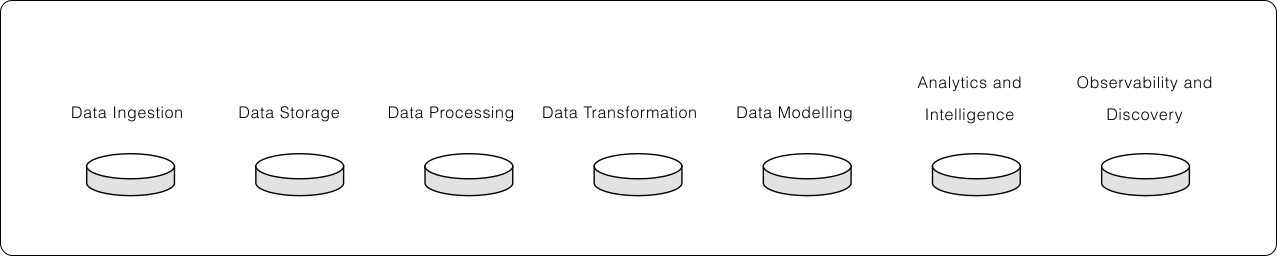
While these core layers are likely to be seen across data platforms, the platforms themselves may vary greatly, based on the purpose they align to.
01. Data Ingestion
Data streams are growing in number and complexity, ingesting structured and unstructured data from across the board is one of the many problems data teams work to solve. One can opt for off-the-shelf solutions like Fivetran, Stitch, Airbyte, or Singer, or teams can build their custom solution.
02. Data Storage and Processing
Before we can draw insight from data, we need to store it in a way that is easier to access and process. It is important to balance current and future needs as the amount of data an organization may store and call upon may increase over time. Most FSIs need a storage mechanism that will simplify their data management, improve security and ownership, and will help them prepare to incorporate future ready-tech like artificial intelligence and machine learning.
Because of these inherent needs of FSIs, on-site data solutions are making way for cloud solutions like data warehouses, and data lakes. There are plenty of solutions providers to choose from, some with open-source offerings, some with proprietary ones. A data warehouse is primed to become an organization's 'single source of truth' A data warehouse offers storage, computing power, and contextual information around the data in it. Generally, there are a few key components to a data warehouse. These are metadata, storage (what is stored, where, and how), and compute (the engine that allows for data queries, transformation, etc). Whereas, a data lake is a centralized repository that allows you to store all your structured and unstructured data at any scale. While data lakes and data warehouses, both store data in some capacity, each is optimized for different uses. We should consider them complementary rather than competing tools, and a company might decide to use both. The key difference between a data warehouse and a data lake is that the former is more structured, and has defined purposes whereas the latter holds raw, unprocessed data. Unprocessed data can be processed in multiple different ways, there is room for possibilities. Processed data has a more linear trajectory and is optimized for specific purposes.
03. Data Transformation and Modelling
Often considered to be the same, they are different. Transformation of data is to ready it for analysis and reporting by applying business logic. To model data is to prepare visual representations to store in a data warehouse (or lake). Data engineers rely on tools like DBT, Dataform, and SSIS for their transformation and modelling needs, bringing data closer to the big step: analytics.
At its core, data transformation changes the values, format, or structure of data and can be:
- Constructive (adding,copying, replicating)
- Destructive (deleting)
- Aesthetic (standardizing)
- Structural (renaming, moving, combining)
Transformed data brings its benefits. Properly organized data is easier to use for both humans and machines. Also, proper formatting and validation reduce the occurrence of null values, duplicates etc. — common pet peeves in the data world. Transformation makes the data ‘usable’
Data modelling, on the other hand, is a representation of the data that can be pulled up in the form of dashboards, metrics, or reports. Without these preliminary steps, one cannot get to the stage of analytics and BI — the ultimate goal of dealing with so much data.
04. Business Intelligence (BI) and Analytics.
Multiple teams in an organization rely on data for their decisions, but they are not expected to have the same prowess and skill that dedicated data teams have. Business Intelligence is the use of data to ensure smooth sailing on a day-to-day basis. Intelligence, in every sense of the word, helps navigate through challenges while maintaining focus on a predefined goal.
For stakeholders of a business to make sense of data, they need some sort of analytics or intelligence dashboard without all of the complicated underlying processes. Put simply, teams that need to drive the car to get to their destination needn’t necessarily know how the engine functions. Looker, Tableau, and Power BI are among the most popular options out there.
Business analytics may be considered parallel to intelligence, it depends on quantitative analysis of statistics and other quantifiable data to determine the future course of action. Forecasting, regression, and correlation analyses are among the few elements of business analytics. Intelligence may be tapped into by different teams as needed. In the case of analytics, dedicated teams may be responsible for drawing out actionable insight from the sea of data being generated and processed in the digitally driven businesses of today.
05. Data Observability
Automation ensures that mission-critical data is not outdated or erroneous. The adage of measuring twice and cutting once holds, especially when big business decisions have to be made. Data is accumulated from multiple sources, in multiple formats, for multiple purposes like marketing or compliance. Dealing with inaccurate or incomplete data becomes a Herculean task as the volume of data dealt with increases.
Organizations need to be able to trust their data, and to achieve this trust they need to consistently monitor it for:
- Recency — How often is the data updated?
- Distribution — Are the values associated with any data point in an acceptable range?
- Volume — The ‘completeness’ of the data
- Lineage — Who is generating the data? Who is using it?
Data observability works the same way health monitoring does. It measures the health of an organization’s data and tackles ‘pain points’ before they can get worse and compound. Observability is a preventive measure that leads to the best use of a business’s resources internally and externally. Good data observability platforms connect to the existing stack without requiring significant changes. They are capable of monitoring data at rest while being in line with compliance requirements, without needing to extract it. A machine learning-powered data observability platform can detect anomalies and dependencies by learning about the environment and the data it will work with.
Internally, data teams and platforms are expensive to maintain, having a healthy data platform and troubleshooting as little as possible frees up the data team’s bandwidth for more important tasks. Externally, relevant and current data gives the business a competitive edge and ‘faith’ in their decision. The data does not act as a potential point of failure. Decisions made with ‘broken’ data could be costlier still as companies scurry to curb any damage done. Data monitoring, quality, reliability, and governance have all functioned in isolation. Data observability is their unifier.
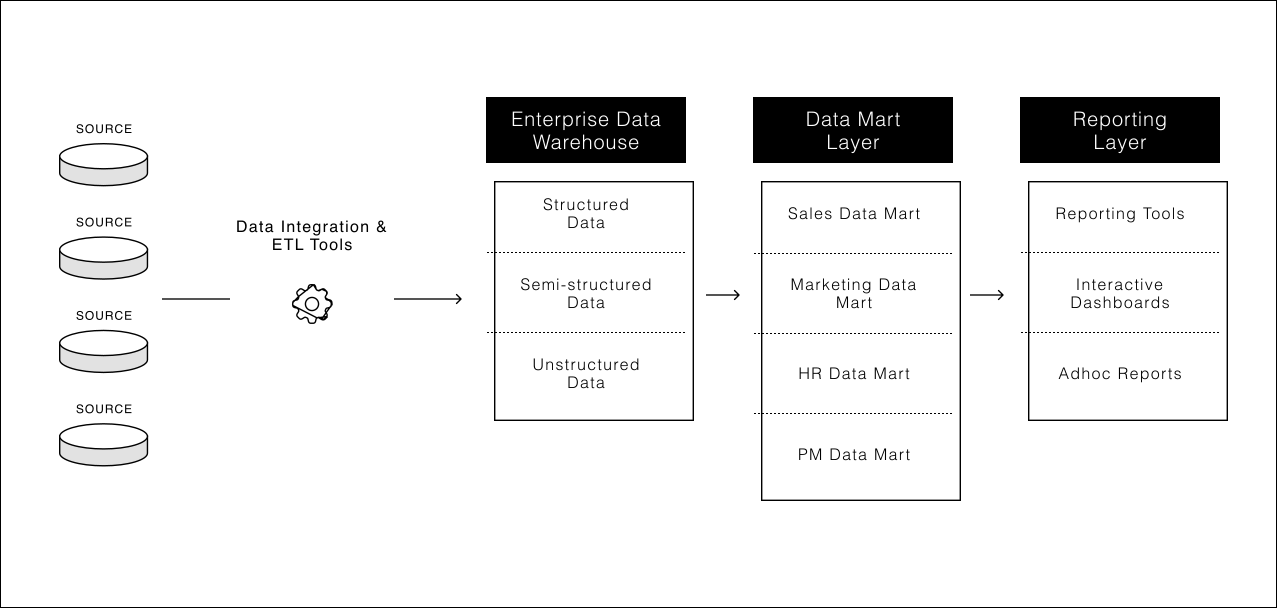
Banks that invest in a data platform see organization-wide benefits. The functions in a data platform unlock back and front office operational efficiencies making the bank agile and more responsive to rapidly changing market conditions and customer expectations.
Numerous banks have put their trust in Lumiq for their digital transformation. Our cloud-native AI data platform enhances the customer experience by 37% and business productivity by 23%.