

Signpost: A BERT-Based Router for Multi-Agent Chat
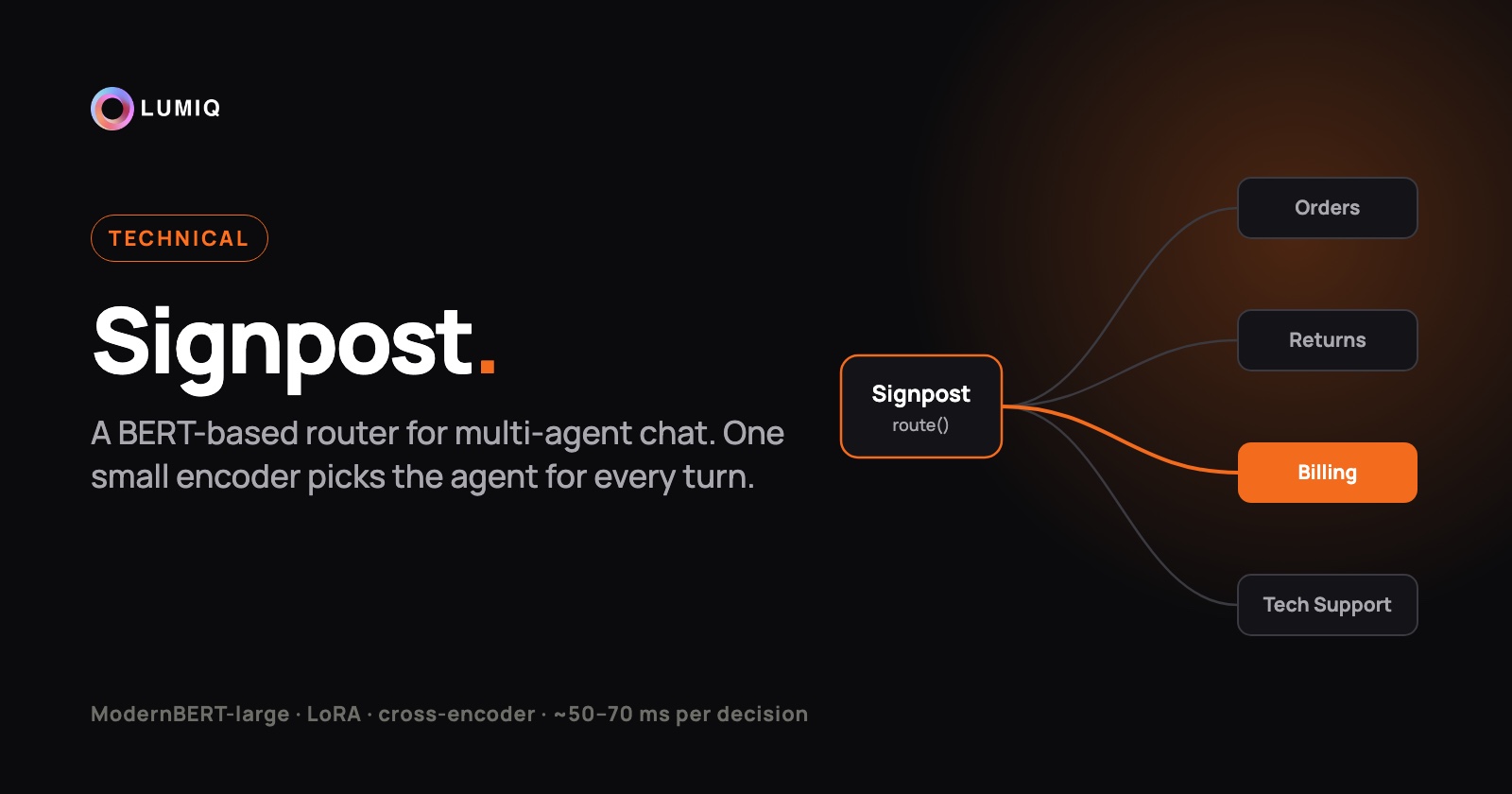
Every multi-agent chat has the same quiet problem at its centre: before any agent can answer, something has to decide which agent should. Most teams hand that job to a large language model, which works, but costs a full generation call on every turn and is slow enough to notice. Signpost takes a different route. It is a BERT-based router for multi-agent chat, built on ModernBERT-large. You give it the conversation, the agent that answered last, and your agents with a one-line description each. It tells you which agent should handle the user's latest message.
The same model also answers grounded questions about a text:
- Yes / no — "Does this convey urgency?"
- Choice — "Which team should handle this?"
- Score on an ordered scale — "How frustrated is the writer? calm / frustrated / furious"
The options are yours and can change on every call. They aren't fixed classes, so new agents or labels need no retraining.
Signpost is fine-tuned from ModernBERT-large (395M parameters, encoder only). LoRA adapters (r 16) were trained and then merged into the weights, and a 0.26M-parameter scoring head was added. That is about one fifth of the size of the 2B decoder-based Strands decider (StrandsAgents/strands-decider-2B-hobson-v19), and on a GPU it takes about 50–70 ms per decision. The model is open source under Apache 2.0 and available on Hugging Face.
How It Works
Signpost is a cross-encoder. It reads each option together with the conversation and the question, one forward pass per option (all options in one batch). It gives each option a score, and a softmax over the scores gives the probabilities. Every call, including routing, is the same "pick one of these options" task:
user: <msg> [SEP] assistant: <msg> [SEP] … [SEP] user: <latest msg> [SEP] current agent: <name or none> [SEP] question: <question> [SEP] candidate: <option>. <description>- Routing uses the fixed question
Which agent should handle the user's latest message?, with each agent's description in the candidate. - Choice uses your question and your options (2–5 in training), e.g.
Which team should handle this?overbilling / sales / retail. - Yes / no uses your question with the options
yesandno. - Score uses your question with ordered levels (e.g.
calm / frustrated / furious), read in order from low to high, and also returns the expected level (Σ index × p).
signpost.py, included in the model repository, builds this input exactly as it was in training. Use it rather than writing your own input format.
Getting Started
Requirements: torch and transformers (tested with 5.17.0; ModernBERT needs ≥ 4.48). signpost.py has no other dependencies.
import sys
from huggingface_hub import snapshot_download

path = snapshot_download("skamalj/signpost")
sys.path.insert(0, path)
from signpost import Signpost

sp = Signpost(path)        # CUDA in fp16 if available, else CPU in fp32
The examples below were run on the exported model, on CPU in fp32. Each # -> line is the actual recorded output, not an illustration.
1. Route a first message
agents = {
    "Orders Agent": "Handles order status, delivery dates, tracking and changing a delivery address.",
    "Returns Agent": "Handles returns, exchanges, return labels and refunds for returned items.",
    "Billing Agent": "Handles payments, invoices, double charges and saved cards.",
    "Tech Support Agent": "Fixes problems with the app, logins and devices.",
}
messages = [{"role": "user", "content": "I was charged twice for my last order."}]
agent, probs = sp.route(messages, agents)
print(agent, {a: round(p, 3) for a, p in probs.items()})
# -> Billing Agent {'Orders Agent': 0.0, 'Returns Agent': 0.0, 'Billing Agent': 1.0, 'Tech Support Agent': 0.0}
2. Route inside a conversation
Pass the history, oldest first and ending with the user's latest message, and set current_agent to the agent that answered last. Signpost then decides whether to stay with that agent or switch to another.
messages = [
    {"role": "user", "content": "I need to send back a jacket, it's the wrong colour."},
    {"role": "assistant", "content": "Sorry about that! Which colour did you receive?"},
    {"role": "user", "content": "the green one"},
]
agent, probs = sp.route(messages, agents, current_agent="Returns Agent")
print(agent, round(probs[agent], 3))          # a short answer stays with the current agent
# -> Returns Agent 1.0

messages += [
    {"role": "assistant", "content": "Thanks, I've emailed you a free return label for the green jacket."},
    {"role": "user", "content": "and my app keeps logging me out, can someone look at that?"},
]
agent, probs = sp.route(messages, agents, current_agent="Returns Agent")
print(agent, round(probs[agent], 3))          # a new topic moves to another agent
# -> Tech Support Agent 1.0
3. Choice
pick, probs = sp.choice("Help! My payouts have been failing for 3 days!",
                        "Which team should handle this?", ["billing", "sales", "retail"])
print(pick, {o: round(p, 3) for o, p in probs.items()})
# -> billing {'billing': 0.908, 'sales': 0.019, 'retail': 0.073}

print(sp.choice("The blue sofa is £899 and the grey one is £749.", "Which sofa is cheaper?", ["blue", "grey"])[0])
# -> grey
4. Yes / no
yes_no returns P(yes); use 0.5 as the threshold.
print(round(sp.yes_no("Help! My payouts have been failing for 3 days!", "Does this convey urgency?"), 3))
# -> 0.987

print(round(sp.yes_no("I'll pay by bank transfer this time instead of card.", "Will the customer pay by card?"), 3))
# -> 0.0
5. Score on an ordered scale
List the levels from low to high. You get back the most likely level, the expected level index (0 = first level), and the probabilities.
level, expected, probs = sp.score("Help! My payouts have been failing for 3 days!",
                                  "How frustrated is the writer?", ["calm", "frustrated", "furious"])
print(level, round(expected, 2), {l: round(p, 3) for l, p in probs.items()})
# -> frustrated 1.2 {'calm': 0.01, 'frustrated': 0.778, 'furious': 0.211}

print(sp.score("No rush, whenever you get a moment.", "How urgent is this?", ["low", "medium", "high"])[0])
# -> low
Using Signpost in a Multi-Agent Setup
Signpost works with any multi-agent framework. Call route() before each user turn, send the turn to the agent it picks, and remember that agent as current_agent for the next turn. That's all the state it needs.
In LangGraph, Signpost is the first node, and the graph jumps to the agent it picks (Command(goto=…)), keeping the current agent in the graph state. The full example has five agents (Claude), a DynamoDB checkpointer and a message-window reducer.
Training
- Base:
answerdotai/ModernBERT-large, frozen. - Trained: LoRA r 16, alpha 32 on the encoder's linear layers (7.2M, merged at export) plus a head: mean pooling → Linear(1024, 256) → GELU → Linear(256, 1) (0.26M).
- Data: 6,319 routing conversations (multi-turn, with the current agent and 5 agents with descriptions, many synthetic companies) and 9,586 grounded questions (yes / no balanced per family, choice, ordered score).
- Setup: 2 epochs, max length 320 tokens (if too long, the oldest history is cut), one seed (42), Kaggle T4, about 33 minutes.
All the training data is synthetic and was written for this project. Before training, it was checked for overlap with the test sets (5-gram and content-word guards).
Evaluation
Signpost is compared with the Strands decider (2B, zero-shot). Both models get exactly the same test items; only the input format differs (each gets its own prompt format). Every number is correct answers / total items, and both models are scored on every item. For routing in conversations, both models see the full chat history.
Test sets
- Routing in conversations (193 turns, 83 at companies never seen in training): 35 realistic multi-turn chats at 13 companies, 5 agents each. Routed live: the model's own previous choice becomes the current agent for the next turn, so a mistake carries forward. Turn types include short answers ("the green one"), follow-ups, closings and switches to a new topic.
- First message (100): a single opening message at 10 companies × 5 agents.
- Banking (50 · 225): single banking customer messages routed to banking agents — a 50-message benchmark and the full set.
- Grounded questions (170: 58 yes / no, 59 choice, 53 score): short texts where the answer is always in the text, including the same text asked two different questions.
- Independent questions (300: 100 yes / no, 108 choice, 92 score): written by a separate author who never saw the project's data, with their own businesses.
- Independent routing (172 turns · 200 first messages): the same separate author, with multi-turn chats routed live and first messages.
Results
Signpost vs the Strands decider:
- Routing in conversations, unseen companies: Signpost 78 / 83 · Decider 62 / 83
- Routing in conversations, all companies: Signpost 181 / 193 · Decider 151 / 193
- First message: Signpost 97 / 100 · Decider 96 / 100
- Banking, benchmark: Signpost 48 / 50 · Decider 48 / 50
- Banking, all: Signpost 210 / 225 · Decider 214 / 225 (banking77 is in the decider's training data, so this set is not unseen for it)
- Grounded questions, total: Signpost 161 / 170 · Decider 160 / 170 (yes / no 58 / 58 vs 56 / 58; choice 58 / 59 vs 56 / 59; score 45 / 53 vs 48 / 53)
- Independent questions, total: Signpost 221 / 300 · Decider 253 / 300 (yes / no 75 / 100 vs 77 / 100; choice 103 / 108 vs 106 / 108; score 43 / 92 vs 70 / 92)
- Independent routing in conversations: Signpost 133 / 172 · Decider 113 / 172
- Independent first message: Signpost 180 / 200 · Decider 178 / 200
Given only the last 3 user turns instead of the full history, the decider does better in conversations (69 / 83, 163 / 193 and 121 / 172), but still scores below Signpost.
Live in a LangGraph app: five agents, with real LLM replies in the history, DynamoDB persistence and a pruned history. 67 / 71 turns were routed correctly: first messages 19 / 20, conversations 31 / 32, resumed after a restore 7 / 7, and a long chat with an 8 / 4-message window 10 / 12.
Latency: on a T4 GPU, about 50–70 ms per decision (p50), which is 4–7× faster than the decider measured the same way. On a laptop CPU in fp32, about 1.3 s for a first message and about 4 s with a long history.
Caveats
- The routing in conversations, first message and grounded question sets were written by the same author as the training data. The independent sets are the fairest comparison.
- These are single-seed results. Three runs of the same recipe varied by about ±4 on most tests, and by 43–53 on independent score.
- The decider ran in bf16 on a T4 without its optimised kernels, so its latency is an upper bound.
Limitations
- Score precision is the weak spot. On out-of-distribution text, Signpost often picks the level next to the right one (independent score 43 / 92 vs the decider's 70 / 92). Use
expectedrather than the top level if a near miss is acceptable. - It sometimes switches too eagerly. A short follow-up whose topic belongs to another agent ("can I use them on the repair?") can be routed away from the current agent. Clear agent descriptions help.
- The probabilities are not calibrated. They are usually close to 0 or 1, so don't treat them as confidence.
- English only. Trained with 2–5 options per question; more options work, but have not been tested much.
- Answers come only from the given text, by design. Questions that need world knowledge or arithmetic are not supported.
- Inputs longer than 320 tokens lose their oldest history.
- CPU latency grows with history length. Keep a window of recent messages, or use a GPU.
Resources
- Model: huggingface.co/skamalj/signpost (Apache 2.0, the same licence as the base model)
- Code, data builders, notebooks and the experiment ledger: github.com/skamalj/llms-the-hard-way
- The exact state that trained and exported this model: tag
signpost-v1.0,lora_combined.ipynbwithTRAIN_MODE=combined,EXPORT=1