

Streamlining Health Insurance Claims Processing : Tariff Digitization and Standardization(Part 2)

Digitizing Hospital Tariff Cards<br/
*This article is co-authored by Abhishek Sharma(Data Scientist), Misha Rana (Data Scientist), and Sampurn Rattan(Lead Data Scientist) working at the Lumiq Research Team.
TL;DR: This blog is in continuation with our previous blog on the same topic. Please find the link to the previous blog Here.*
The story of health claims is the story of documents. The hospital rate list document is just the first piece of it. This very first document is massive, infinitely heterogeneous and completely template non-adherent. This document generally runs into multiple hundreds of pages even for the smallest of hospitals. In this blog, we see that simply extracting information from this document is not enough, and what more needs to be done.
But, what is a Schedule of Charge (SoC), after all?
If you have been in the hospital, you will receive a bill listing the charges. Hospital bills can be complex and confusing. This is because a hospital not only provides medical services but also has room charges, food charges, medical personnel charges, equipment charges, and management charges.
A hospital schedule of charges — also known as the tariff card, rate list, or memorandum of understanding — is a contract between a hospital, a patient, and an insurer detailing all possible services (and related charges) that can be availed by the patient.
Since it contains all services and goods a hospital can provide, most hospitals have a pretty large SoC. And since many services are difficult to articulate and quantify (because medical procedures, in general, are difficult to articulate and quantify), many charges are listed in a highly atypical manner. Along with these complexities, another major complexity is that different hospitals use different terminologies for the same line item.
Let us walk through the solution Drishti Document AI has created by discussing the benefits and end-goals of the solution.
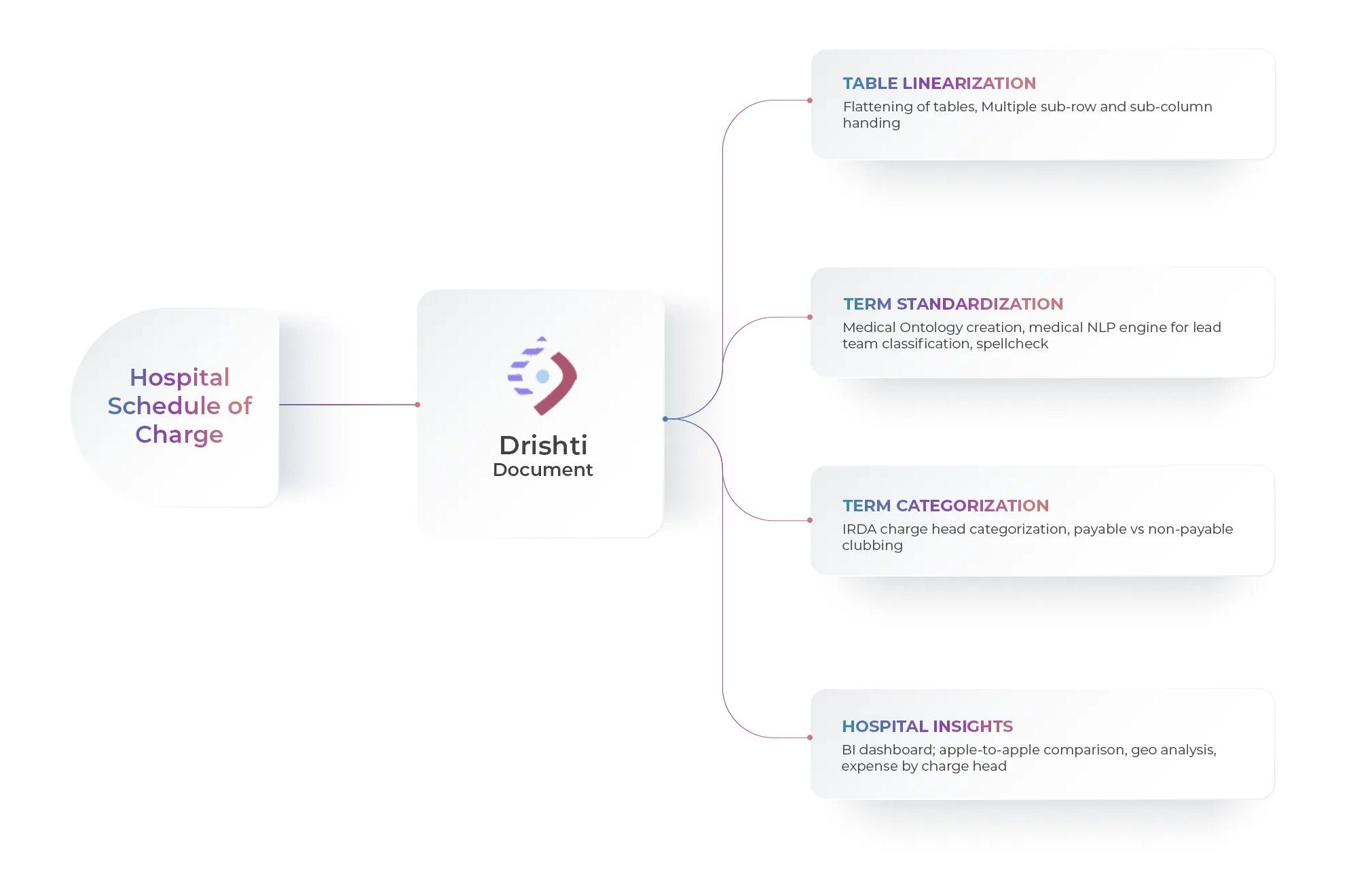
Table Linearization
One major quirk of hospital pricing in India is that the cost of a procedure is not only dependent on the procedure but also on the room type the patient is in. This tiered pricing approach allows hospitals to charge more for the same procedure — but only to those who can afford it, and allows a lower rate for people who need it the most.
As such, one of the first steps in digitization after text extraction is to flatten the charge list by the room type — that is, each service will have as many rows as there are room types.
For example, the following is a snippet of a Schedule of Charge:

Which becomes:
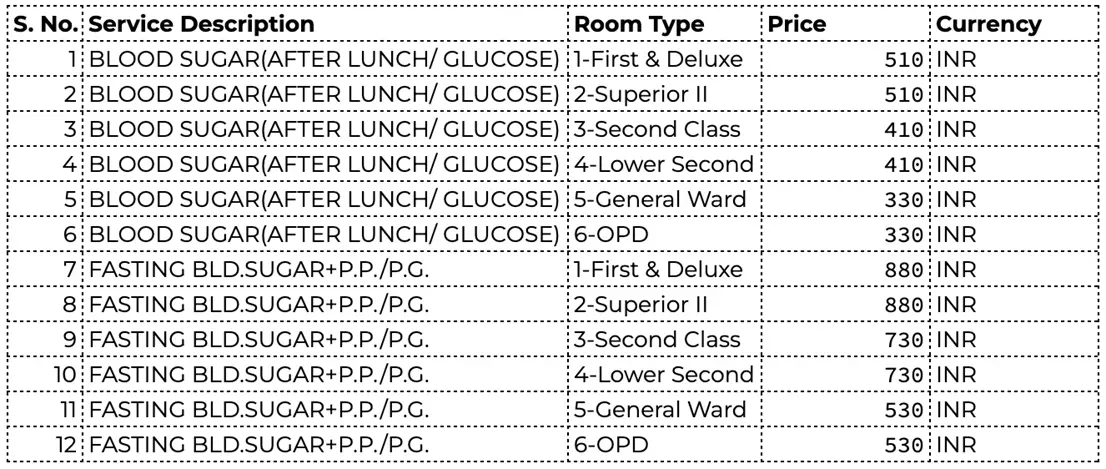
This long format table (as opposed to the wide-format) will allow a better understanding of the document for humans, as well as databases and machines.
Another issue we faced whilst flattening was the presence of tables with sub-rows and sub-columns.
Taking one of the simplest examples, the following room rate list:
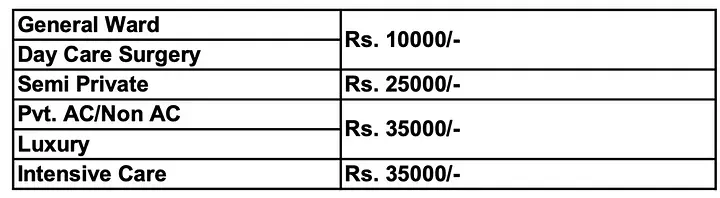
Becomes:
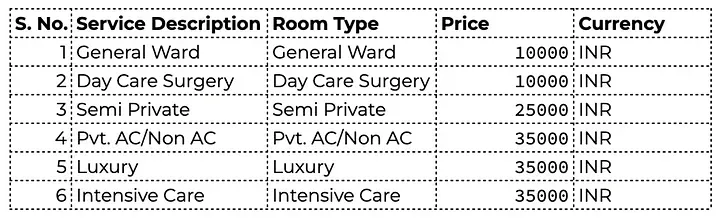
Each row is populated with its correct price to enable proper database persistence.
Term Standardization
Different hospitals have different names for the same test or procedure. One way to resolve this is to maintain a medical ontology and transform each term into its standardized synonym. Another way is to use pre-existing vocabularies and ontologies, and apply them to each term. Two very popular examples are the ICD-10 and SNOMED-CT codes. These terminology corpora provide a common language that enables a consistent way of indexing, storing, retrieving, and aggregating clinical data across specialties and sites of care.
For example,
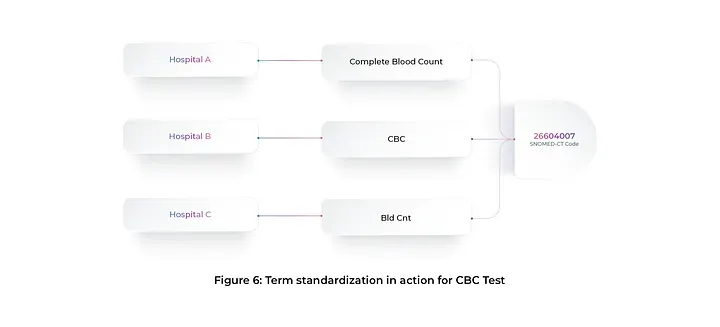
This standardization ultimately helps in categorizing each line item, and massively reduces subjectivity for the adjudicator and the patient. Any spelling corrections are also done at this stage.
Term Categorization
After multiple consultations with multiple insurance providers, we came to the conclusion that a medical bill (and thereby a hospital SoC) can be divided into the following 19 categories:
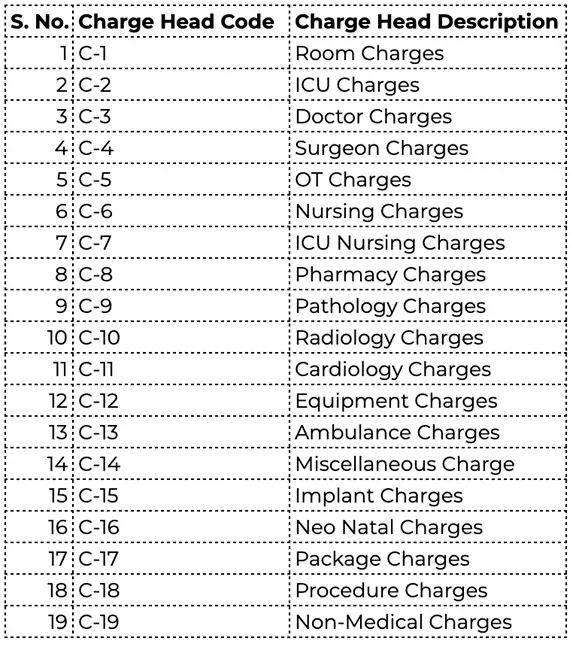
These charge heads are used everywhere from Audit, New Business, and Compliance to Claims processing. There are no rules or any pre-existing model for this classification exercise. Instead, we manually created a massive dataset for this exercise — validated by medical Subject Matter Experts (SMEs) and medical adjudicators. We then trained a deep learning classifier which gave excellent accuracy (99%+).
Insurers also use the above classification to convert bill line items into payable and non-payable charges. Non-payable charges are not covered under any insurance policy, and the patient is liable to pay the same. They generally account for a very small percentage of the total bill.
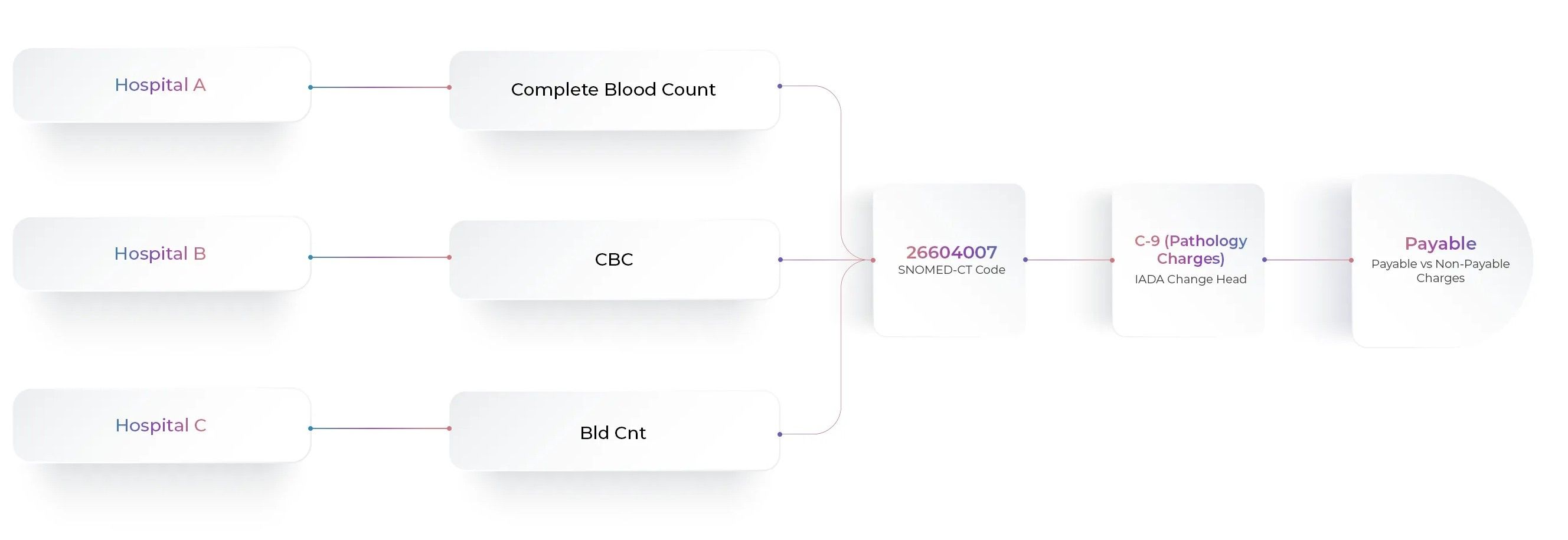
This payable vs non-payable dichotomization at this stage helps the medical adjudicator by automating the classification — this also reduces the subjective opinions of medical adjudicators of which line item to classify into payable and which into non-payable, thereby bringing an objective standardization at this level, as well.
Hospital Insights
All this granular level information can allow any insurer to aggregate data and analyze the entire business flow as a whole. The greatest advantage of SoC digitization would be the ability to compare two different hospitals in an apples-to-apples comparison as all fields between two separate hospitals have been standardized into one singular term.
Insurers can not only review their business by geography and hospital, but now they have a view of the major health concerns within each geography.
For example, insurance companies can check what are the most common services offered in, let’s say, Mumbai — which, in turn, is pushed by what are the most common services requested by patients in Mumbai. Insurers, armed with this knowledge, can release geography-specific products. This will allow them to be truly customer-first.
Many more analytics use cases come to mind limited only by imagination — with data comes the power to do data analysis.
Conclusions
Overall, this digitization exercise takes on the following four critical questions:
- Is the patient’s identity correct?
- Are the prices on the bill correct?
- Do the diagnosis and treatment map correctly to the line items in the bill?
The hospital schedule of charges is just the first chapter of the health claims story. The next logical step would be to digitize and standardize medical invoices to automate and assist in billing adjudication. However, this answers only the second question.
To answer the remaining above questions, we have to digitize the claim form and identity documents (Is the patient identity correct?), and then medical reports, discharge summary, and doctor prescription (Do the diagnosis and treatment map correctly to the line items in the bill?).
We discuss information and inference extraction from the same in the final blog of this series.
To know more about Lumiq’s intelligent document processing capabilities, visit us at https://lumiq.ai/drishti/
We also used Drishti to automate customer onboarding for one of the biggest insurers in India, to know how we achieved it, also read Automating customer onboarding with Lumiq Drishti.
For even more information, ping us at drishti@lumiq.ai